Showing posts with label That Petrol Emotion. Show all posts

Wednesday, 31 March 2021

That Petrol Emotion: "Genius Move"


"I like what they do because it sounds like they're enjoying themselves and it sounds like they could go wrong and I like that in a record. They are a group that's got integrity."
— Robert Smith

Integrity. Integrity. Not a word you hear a lot in music circles anymore (to the extent that I'm not sure whether to poo-poo Robert Smith for being so cliched and dated or if I should tip my hat to him for being so bloody novel). It's an obvious throwback to simpler, more rockist days when you were supposed to play your own instruments and write your own songs. A term frequently used yet seldom expounded upon. U2 allegedly had integrity but Rick Astley didn't and no one ever bothered to question this line of thinking; it was true simply because that's what we all believed.

I've knocked populism in the past in this space but it's worth considering that its forerunner wasn't up to much itself. Rockism was all about the dogma that old school rock 'n' roll values were all that mattered. It's why Bruce Springsteen remains slightly overvalued and why Tom Petty is worshiped for making a career out of creating the same pleasant but unremarkable Tom Petty records. Why power pop is considered a gold standard yet is all-too-often boring. Schoolmates who liked grunge or gangsta rap belittled me for being into Pet Shop Boys and Depeche Mode (even though members of both groups wrote their own songs and played their own instruments) because my stuff was "queer" while their's had a "message". Exploring past eras, Led Zeppelin was revered but ABBA was a "guilty pleasure" (again, the Swedes wrote their own songs, something the drunken Brummie foursome didn't always do). For all its sins, at least poptimism is all about judging the quality of music, not the supposed "integrity" of the artists.

I'm not sure Robert Smith is a rockist (I'd be very surprised to discover that's what he is) but integrity is important to him. The Cure grew out of punk and that generation was as protective of its spirit as they were down on the prog rockers and stadium theatrics that came before it. Keeping the flame of punk going in the indie scene mattered to a lot of people in the underground, especially with 1987 being the most eighties year imaginable. The writing/production assembly line of Stock Aitken Waterman was beginning to dominate the charts (Smith also reviews Astley's tepid follow up to "Never Gonna Give You Up" and has already had enough of them), rock dinosaurs were back and the post-punk generation was beginning to fade away so it's no wonder a fragment of what had been part of the scene ten years earlier would be so warmly greeted by some.

All this may read like I'm dumping on Smith's stint as singles reviewer but there's lots to enjoy in his write up. He makes several amusing remarks (of Astley's "Whenever You Need Somebody", he says "I'll probably find myself completely mortalled in Fellini's disco in Stockholm and dancing to this"; of The Fat Boys' Falling in Love", "...it's a very thin foundation on which to build your career — being fat. I speak from inexperience of course"; the great thing about the latter is that it's funny whether Smith means or not, especially given the rounder state he is in of late) and some of his tastes mirror my own (I think I love him just a little bit more because of how much he hates Eurythmics). He does better when trashing the records he doesn't care for than when he struggles to provide much of substance to say about his favourites — and I don't blame him. All in all, he does well in the role and was good enough to be asked back for a second time (he, in turn, must have enjoyed the task enough to have accepted the invitation) which we will get to next year.

This is the second appearance on this blog for That Petrol Emotion, the first being earlier in the same year when Shane MacGowan gave his approval to "Big Decision". It's notable that two guest reviewers who were close to the same age and both children of punk would be their biggest supporters in Smash Hits. The single "Swamp" was released in the summer of '87 but no one bothered reviewing while Barry McIlheney gave a positive critique of their album Babble, one that didn't fawn over the group's "integrity". The likes of NME and Melody Maker were enthusiastic of them but they, too, were there to keep the punk fires burning in the indie scene. While they didn't go so far as to brandish the word 'integrity', there was always a sense that they were championed by people who admired what they stood for rather than what they created.

"Big Decision" didn't do much for me either but at least a vague hint of its chorus and tune has stayed with me over the past few months; on the other hand, I've been listening to "Genius Move" over the past week and I still can't remember anything about it. I put it on and it goes about its business as if refusing to want my attention. As is inevitable, Smith mentions the connection to The Undertones, a band he used to like though not love since he never cared for Feargal Sharkey's voice. And, yeah, the Shark's singing is an acquired taste and I can understand it not being everyone's thing but implied here is a preference for the generic vocals of Petrol frontman Steve Mack. And while the young American doesn't ruin "Genius Move", he isn't able to make it rise above the competition either. And no one does in the end. There's nothing wrong with it except that it's just another pained indie hopeful in a scene drowning in them. You may believe that alternative acts from the eighties are "overlooked" or that they "deserved a bigger audience" — just don't say "criminally underrated", a term that no longer has any meaning — but the special groups tended not to fall through the cracks. Groups that were much better than That Petrol Emotion, though they did have integrity, I'll give them that.

~~~~~

Also Reviewed This Fortnight

The Jesus & Mary Chain: "Darklands"

Smith considered the latest from the Reid brothers for SOTF and he would've done better had he gone with them. A little less thrilling than their early work (Smith admits it "isn't particularly stunning" and implies that he's much fonder of The Jesus than the single itself; I suppose they oozed integrity too), "Darkness" requires more time to digest but the listener's patience is rewarded by the multitude of hidden depths. As Smith notes, the Reids were masters of pinching melodies and riffs from a bevy of sources and making it seem like it was all their doing. They sound less like The Velvet Underground here but that could just be because they sound more like everyone else. Amazingly, no one managed to sound like them.

Wednesday, 23 December 2020

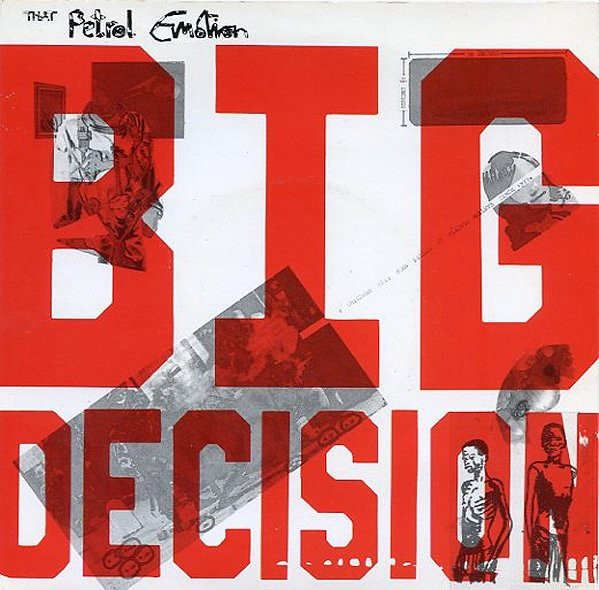
That Petrol Emotion: "Big Decision"


"D'you want me to be more sort of "this is good" or "this is crap" or something?
— Shane MacGowan (with Sylvia Patterson there to hold his hand)

I've been on a "kick" as of late by relating the music of 1987 to the early part of the decade. Of the previous seven entries, only one SOTF is by an artist that didn't establish themselves a few years earlier (take a bow, Fuzzbox). Four of them are by people who appeared on Band Aid's "Do They Know It's Christmas?" (though I was stunned to discover that neither Aretha Franklin nor Prince are on the American equivalent record "We Are the World" by USA for Africa; for what it's worth, Corey Hart is one of the "featured" soloists on the Canadian contribution to the Ethiopian famine relief, Northern Lights' "Tears Are Not Enough") A "second Great Eighties Pop Boom" (as Sylvia Patterson dubbed it in her fine memoir I'm Not with the Band) was right around the corner but until then it was a matter of dealing with those who had survived the first rush.

There's somewhat of this same spirit present this issue as well. Derry's That Petrol Emotion are newish but they are a direct descendant of Ulster punks The Undertones and, thus, actually predate the likes of Boy George, Duran Duran and U2. Rather than representing a coming together of Northern and "Southern" Ireland through peaceful defiance, as symbolized by Bono, ver Tones were young people who lived through The Troubles as though it were an everyday part of life. The fivesome of Feargal Sharkey, John and Damian O'Neill, Michael Bradley and Billy Doherty were the sort of Irish youths who might not have given a toss about the issues surrounding sectarian violence but for the fact that it surrounded them in the process. Their songs from "Teenage Kicks" on aren't about terrorism, they're about getting through life in spite of it.

The Undertones were a fantastic band and I only wish I could have encountered them when I was fourteen or fifteen and full of angst and bitterness — though, strangely, I feel far more at home as a man in his forties listening to their frothy, youthful anthems than I do the more grown-up (and humourless) Clash. But it couldn't last and the group made a brave crack at maturity which only kind of works. One of the earliest pieces on this blog, "Julie Ocean" was almost a hit single and represents their last gasp of creativity but one that lacks the passion of old. This Undertones was no longer a punk outfit of any kind.

With Sharkey's departure for a solo career, the O'Neill brothers decided to head back up to Derry to start over again. This was a brave move on their part: they could have easily remained in London to form a group with other aging punks on the scene; they also could have taken off for New York or LA to hook up with fellow expat musicians and studio warriors — these were the more natural paths for your average erstwhile guitarist. But they went back to their roots and reconnected with some old hands on the Northern Irish indie circuit. They then swiftly returned to London and had soon discovered a young American on a working holiday.

That Petrol Emotion were not trapped in the shadow of The Undertones. They had a sound that sparks with an alt rock verve much more typical of the late eighties than a decade earlier (they even had their eyes on the emerging hip hop and house scenes which they sadly only touch upon here) This is most obviously found in singer Steve Mack, for good or bad. Wikipedia describes him as "charismatic" and that's even clear from just listening to him. He has that sort of voice of a cocky frontman of a power pop band that is of moderate importance on US college radio, which is also pretty much what "Big Decision" amounts to. The guitars are chunky but repetitive and it all boils down to competence rather than inspiration.

So, once again, veterans of along lost UK music scene struggle to find a place in a changing culture. Though roughly of the same generation, The Jesus & Mary Chain — also reviewed this fortnight with the blistering "April Skies", a single that Shane MacGowan seems much more enthusiastic about — had a far greater grasp of translating punk into a contemporary indie aesthetic.The Smiths had pop hooks to set them apart, even if their best days were already behind them. New Order still had the D.I.Y. graft that always did them good. But That Petrol Emotion lack that something to make them stand apart and you almost wish they had a bit more Undertones in them.

The singles were reviewed by Shane MacGowan of The Pogues, a group many North Americans assume to be Irish. A tip of the cap to Sylvia Patterson for her role "listening in". This is the first time a Hits scribe has been given a co-credit and it's one that is well deserved. MacGowan is barely coherent as it is so it's a good thing she was around to make some semblance of something readable for the pop fans out there. For his part, MacGowan does a decent job though he struggles to express a great deal more than appreciation or hostility. He is, however, able to relate to various pop records and they aren't just those you might expect. My expectations for musicians doing the singles aren't especially high and I'm just glad he doesn't act like a total git. Which is more than can be said for the next pop type who reviews the singles — and one who just so happens to be yet another throwback to the early eighties pop boom. You won't have to wait long.

~~~~~

Also Reviewed This Fortnight

Chris & Glenn: "Diamond Lights"

Aka "Hoddle and Waddle" as MacGowan suggests (and, to be sure, it's a much better name). Members of Tottenham Hotspur F.C. are no strangers to recording pop songs from "Ossie's Dream (Spurs Are on Their Way to Wembley)" to Gazza's "Fog on the Tyne" though it's disappointing that this proud tradition hasn't been taken up by the likes of Harry Kane and Son Heung-min — and with K-Pop at its zenith, this would be the perfect time to strike while the iron is hot so get on it lads! I wasn't familiar with this and assumed that "Glenn & Chris" was just another name for the pairing of Difford & Tillbrook formerly of Squeeze. Instead, it's a pair of standout midfielders from English football's best non-Merseyside squad of 1986-87 First Division, as it was known at the time. Not one to shy away from the spotlight, Hoddle puts his "all" into his breathless vocal while the more reserved Waddle mumbles along as though embarrassed by (a) his stab at pop stardom or (b) by his partner's bravado. And who can blame him?

Kim Wilde: "Love Blonde"

21 July 1983 "Now that summer's here, I suppose the charts are likely to be groaning under the weight of a load of sticky, syrupy s...