Wednesday, 19 June 2019

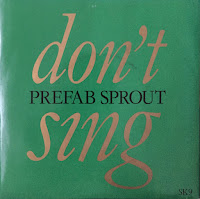
Prefab Sprout: "Don't Sing"

19 January 1984

"The time changes and chord sequences remind me of Aztec Camera and this can only mean a) a hit; b) a severe rise in credibility; or c) hopefully both."
— Martyn Ware

Patrick sat at his desk and rubbed his eyes. He was up late, much later than usual. He had been engrossed in tales of clergymen in Central and South America and what they got up to so far from the prying eyes of the Vatican. Some drank, some killed, some had sex 
— and quite a few did the trifecta. Patrick had never been tempted by such things and his only vice had been a bottle of coca-cola every afternoon. He didn't pity these men of the cloth who had strayed but neither did he envy them: he just wondered how they could have possibly existed in such a state.

But he found himself admiring many of these rogue priests. Yes, these bishops and Monsignors had sinned but a great many refused to benefit themselves financially from their situation nor would they toe the line of the French and Spanish and Portuguese colonial masters they were expected to defer to. Priests served their communities and if a little dodgy moonshine, some blood spilled at the expense invading hordes and the odd bit of rumpo during confessional was the price to pay then so be it.

Patrick never went on to become vicar and likely never harboured a sneaking regard for Catholic clergymen in the new world (save for one). He gave up the priesthood in order to follow his ambitions in the world of pop. Patrick McAloon became Paddy McAloon: his music tastes remained catholic and so, too, did his material.

In a recent exchange on Twitter on how overused and tired the term 'underrated' has become in assessing music, pop critic and Hits alum David Hepworth mentioned that "some people still say Nick Drake is underrated. I think they mean he didn't get in the charts". (I'm not at liberty to provide a link but if you happen to seek it out on your own, please note the not-at-all unhelpful comment below from a certain "underrated" blogger) As fans, we tend to have favourites who we feel have been overlooked, either commercially or critically (if not both), which sort of puts them into an unwinnable scenario: we gripe when they aren't bigger but then we bemoan that they've sold out when they attain some success. 

Prefab Sprout wasn't a group I grew up with, keenly followed over the years and gave a voice to my awkward adolescence. Rather, they were the kind of thing I would dabble in as I entered adulthood. I had always had a thing for British songwriters with less juvenile interests and adult themes: my avowed admiration for Neil Tennant's marvellous observations led on to an interest in the tender, grotesque tales of Paul Heaton and then on to Billy Bragg and Morrissey and Paul Weller and Elvis Costello and Andy Partridge. McAloon's material was the next step but I never had a Prefab Sprout phase to obsess over. I'd give them a listen for a bit, move on and come back to them eventually: never fully immersed but never sick and tired either.

Understanding Prefab Sprout is something a lot of people have to work on over the years. Smash Hits didn't seem to take to them from the off (in a previous review of their debut single "Lions in My Own Garden (Exit Someone)", Dave Rimmer remarks that it "sounds like a speeded up Aztec Camera"; it seems that comparisons of McAloon's talents to ver Camera's Roddy Frame were fairly commonplace during this early stage) with jabs at their silly name dogging them for quite some time. Heaven 17's Martyn Ware is by all accounts a clever chap who does well in his turn in the reviewer's chair but he doesn't offer up much by way of analysis of his chosen SOTF, mentioning passing similarities to The Associates ("but without Billy's wonderful voice", he notes) and, again, Aztec Camera. And I'm no better. Those jangly northern bands could easily be lumped together and it's not a slight on any of them.

Baring in mind that this was just the third single from ver Sprouts (and likely the first to get much in the way of wide distribution outside of the group's Tyneside stronghold), few would have had any idea where "Don't Sing" was coming from, assuming they cared enough to find out. Any concept of understanding Paddy McAloon's genius would have been minuscule at the time. Underrated? Hardly. Within a year many fans and hacks would be singing the praises of this unique little one-off band from Newcastle with acclaim far outstripping sales. Misunderstood? For sure. I, for one, am still misunderstanding their brilliance to this day.

~~~~~

Also Reviewed This Fortnight

Violent Femmes: "Gone Daddy Gone"

You're seventeen and you still haven't snogged a girl, much less touched her goodies. Your best friend may have done (he never got round to spilling the details but who wants to hear about other people having sex when you're not getting any?) and even if he hasn't there are seemingly streets of girls more than happy to do just that to him and these are the very same birds who don't want to have anything to do with you. His girlfriend isn't your type but you can kinda see what he sees in her and, anyway, you wouldn't say no, would you? You've never had anything to do with (The) Violent Femmes before but they're her favourite band and suddenly he likes them and now they're a part of your life too. You feel like you ought to hate them and you tell him they're all right but you like them an awful lot more than you let on even though they're a group for girls who have boyfriends who'll never be you. But, as I say, she's not your type anyway so what difference does it make?

Wednesday, 12 June 2019

Eurythmics: "Here Comes the Rain Again"

5 January 1984

"If Eurythmics think they're making a run-of-the-mill record, they don't panic. They simply add the 'squint factor'. It turns an everyday event into a Royal Variety Performance."
— Ian Birch

Let's perform a thought experiment. Annie Lennox and Dave Stewart form the duo Eurythmics from the ashes of their previous group The Tourists in the early eighties. They go on to record the same eight LP's and rack up dozens of hits in the UK but their American chart fortunes dwindle following the chart topping success of their breakthrough "Sweet Dreams (Are Made of These This)" in 1983. Do North American critics and listeners look upon them any differently than they do now?

One-hit wonders are fodder for endless fascination among fans and people who like to compile lists. Though the songs are often fondly remembered, singers and groups that produced them are typically ridiculed for failing to notch a second smash hit single. British acts such as Soft Cell, Dexys Midnight Runners and Madness all have the supposedly dubious distinction of being one and doners (though surely that solitary hit is better than having none at all) in the States but they are now joined by many who may have had more hits at the time but who have been consigned to a de facto one-hit wonderdom by radio and playlists opting for that one single worth remembering. Thus, Eurythmics have effectively become one-hit wonders.

I think I understand what Ian Birch is on about when talks about the 'squint factor'. It reminds me of hearing Miles Davis' renowned album Kind of Blue for the first time during the glorious summer of 1997. I had previously expressed nothing but contempt for jazz but I was curious and decided to give it a go. I was impressed with the modal playing of Davis, Coltrane, Evans and the rest but it struck me as deliberate and too perfect, a far cry from the spirit of impromptu freedom associated with jazz. Then I got to the CD bonus track, an alternate take of album closer "Flamenco Sketches". Commencing with much the same slow moving piano and bass as the original version, I was startled by the shrieking notes played by Davis to kick things off. I braced myself for some more piercing trumpet sounds that I was convinced were coming only to find myself laughing at having keyed myself up for something that failed to materialise. The squint factor, I would gradually figure out even if I never used the term until now, is all over jazz.

But here? My expectations for Eurythmics amount to lyrics that seem deep until a moment's pause for thought reveals very little, the accomplished vocals of a wise Lennox who I don't really care for as a singer and videos starring a pair who seem to be above it all. No squint factor here, I'm afraid. Luckily, the song's all right and was released among a January wasteland of lousy records Ian Birch had to review. The melody is pleasant and Lennox seems to be using a degree of conviction in her reading. It's nothing terribly special and it leaves the unsettling feeling that pop was quickly shifting from teen audiences on meager allowances to more well-to-do middle-age types with disposable incomes. If only Eurythmics had been a few years younger: there's a thought experiment for you.

~~~~~

Also Reviewed This Fortnight

Wang Chung: "Dance Hall Days"

Another de facto one-hit wonder, "Dance Hall Days" made the charts in North America but it soon became overshadowed by the iconic "Everybody Have Fun Tonight" (which failed to do anything in Britain, making them a true OHW in their homeland). In this case, it must be said that the public were right to forget all about the Chungs first hit. Did these dance halls they speak of feature similarly boring tunes? The one saving grace may be found in having fun rhyming different body parts. How about "take your baby by the tooth / you can get down, that's the truth"? Or "take your baby by the hip / take a trip and spare the whip"? Or "take your baby by the tongue / it ain't time for some Wang Chung"? (I'm keeping ones about rude body parts to myself, thank you very much) 

Wednesday, 5 June 2019

Adam Ant: "Strip"

8 December 1983

"Strange to relate, I rather enjoyed this one. Phil Collins does a nice production job with a jerky beat and minimal strings while Mr Ant sings the praises of taking one's clothes off. In fact, he positively encourages the practice."

— Dave Rimmer

I didn't make a lot of rules for myself when I was in the midst of getting this blog started about fifteen months ago but one that I have really tried to stick to is to never dismiss a song because I reckon it to be "dated". As I believe I've already mentioned, saying music hasn't aged well is usually impossible to prove, serves little purpose and is kind of a cop out argument. Okay, so an eighties record has fairlight synths and a LinnDrum machine on it and thereby it's dated — except for when it isn't. More importantly, I often find it's a point I make when I have absolutely nothing else to contribute in terms of criticism.

I'm going to toe ever-so close to breaking this rule of mine here, however, with my claim that you had to be there to appreciate Adam Ant. I'm sure that his fans in the early eighties still love his music to this day but I'm equally confident that they struggle mightily with passing this appreciation on to their children or other impressionable youths. I'm fairly confident that had I been born (a) ten years earlier and (b) in Britain I would have been a committed Antmaniac or, failing that, I would have at least understood just what everyone else saw in them. But I was born (a) in 1977 and (b) in Canada (where "Goody Two Shoes" was a Top 5 hit in the early part of 1983 but I was too busy prancing around our basement family room to the sounds of Sesame Street Disco to pay any attention to the charts) so his appeal goes right over my head. His hit singles aren't particularly exciting (some are downright boring), he isn't a great vocalist and I'm not sure I even find him an especially fetching frontman. (Although many a YouTube comment would indicate otherwise, is comparing the singer's swagger to Johnny Depp's Jack Sparrow really even much of a compliment anymore?)

So, his records don't do much for me but that doesn't mean I don't hold our Adam in some esteem. His abrupt decision to turn his punk S&M Ants into a shameless cosplay pop outfit alone deserves praise from those of us who rolls their eyes at the mention of self-righteous complaints of indie folk who've "sold out". Here, he's all about flaunting seasonal conventions. Last week, we encountered Paul Young's ode to the virtues of poverty "Love of the Common People". Joining him were the likes of The Flying Pickets ("a pretty song", as Jools Holland describes it), The Thompson Twins ("a big hit": it probably didn't hurt that ver Hits chose to have it reviewed in two consecutive issues), Slade ("no hint of the old Slade") and ABBA with the  annoyingly self-congratulatory "Thank You for the Music". A fortnight forward and Dave Rimmer was tasked with sifting through slush from UB40 ("crisp but quiet"), Rod Stewart ("a typically dippy love song") and bouncy yet plodding hack work from Billy Joel. Yes, the race for the Christmas Number One was on and smooch-tastic weepies and/or slick pop-rock looked to be the best bets for the coveted spot.

Bless him, Adam Ant chose a different direction for his take on a holiday favourite. While the post-punk snotty attitude had largely been drained from his sound by this point — no doubt aided by having the in-demand Phil Collins doing production/session work as well as a guest backing vocal from ABBA's Anni-Frid Lyngstad — Ant couldn't help but be a giant perv, a quality he couldn't quite shake despite long ditching the fetish gear. That his nibs would've enjoyed a fair amount of rumpo with ver ladies is something he hardly kept secret in his videos but this one takes it one step further. While he and his belle never quite get round to removing all their clothes (had this vid been made a decade later we might well have been "treated" to a buttock or even a deft VCR-paused areola sunrise) all indications are it won't be long they're starkers. Not exactly what the public had in mind for an Antxmas and good on him for doing so. But while the lyrics and visuals are suggestive, the record itself isn't up to much and nowhere close to as sexy as he must've been hoping.

Having recently been a teen idol, Ant's fans had by now departed for Duran Duran and Spandau Ballet and Wham! and weren't going to have anything to do with "Strip". Slightly older listeners may have stayed out of loyalty but clearly not enough as it only managed the Christmas Number Forty-One spot. The Dandy Highwayman's days as a top flight pop prince were done but at least his streak ended with a flourish of activity, gunning for something which he couldn't quite pull off. And it's not like it was ever all that good so it's not like it's aged badly or anything.

~~~~~

Also Reviewed This Fortnight

Dislocation Dance: "Show Me"

Rimmer's not overly impressed and I'm sure this was a none-too-special record back in the heyday of tidy eighties indie pop but it's a blinding banger to these ears in 2019. (I never said I may not describe a single as having 'aged well' did I?) Those Chic-esque chugging guitars were by this point more of a hallmark of the Rough Trade sound than their disco/funk roots and it wasn't as if having an angsty female vocalist was especially novel by this time. Still, "Show Me" is catchy and engaging and a welcome reminder that future James member Andy Diagram is a don of pop trumpet playing. There aren't a whole lot of other pop trumpet masters out there but I'm sure they go the jazz and/or classical routes because they know they'll never measure up.

Wednesday, 29 May 2019

Paul Young: "Love of the Common People"

24 November 1983

"...it's hardly any surprise to discover that the panel unanimously voted it "a whopper"."

— Jools Holland

Allow me, before I begin, to drop in a pair of aphorisms I've written especially for this week's post — "in a world in which everyone is a critic, who critiques the critics?" and "sometimes you bite the panel and sometimes the panel bites you". I read "national" "treasure" Jools Holland's singles review guest spot and I've decided to assemble my very own panel of four very real, in no way conjured up in my imagination members of the public to go through them with me and provide their thoughts. We've decided to go through it subject by subject.

~~~~~

"Crazy Over You" vs. "Love of the Common People": The Single of the Fortnight Wars

So, technically, "Love of the Common People" isn't this issue's SOTF. True, it earned 'Whopper' status from Holland's panel and more praise than any other records up for consideration but someone decided to shove their own single on, then bashed a panelist for rightly pointing out a conflict of interest and unilaterally declared it to be "Single Of The Week" (sic.) "...if not The Decade". I'm glad at least one person thought highly of "Crazy Over You". I don't care about the ethics of choosing your own single — we'll eventually get to a couple examples of exactly that on here — but there's something a bit off about using your position as guest reviewer to get your own record on. Plus, the panel didn't have anything to contribute (either that or Holland didn't wish to include whatever they may have had to say). Finally, it's probable that this was all just a big joke: I mean, really, not even Jools Holland could have liked this lousy record, right? My panel agree that "Crazy Over You" sucks but they don't care about my justifications for disqualifying it from being SOTF. They're quite the jolly gang, this lot.

Jeff Lynne Ain't Fat and Neither Is His Production

Perhaps Holland couldn't bring himself to say anything positive about the latest from Electric Light Orchestra because it's not up to much, not even ELO by numbers. So, he goes off on a long-winded thing about the fat production but that we shouldn't confuse that with Jeff Lynn's (sic.) weight or something. Helpful. The panel had never stopped to consider the great songwriter's body-mass index before but clearly aren't interested in a deeper-dive. Fumbling for quite what to say, I mention that I'd like to form a jazz Electric Light Orchestra/Emerson, Lake & Palmer tribute act called 'Electric Lake Quintet' (because, you know, ELO, ELP, ELQ!) but they remain unmoved. Where did I dig up these lifeless dullards?

Nope, Not at All Condescending

"Love of the Common People"? Yeah, best not talk down to the lower orders, treat 'em with dignity and respect.

"...of Channel 4's The Tube"?

I'm surprised to see this brief descriptive below His Nibs' name since (a) he's bloody Jools Holland and surely everyone knows who he is and always has and (b) has he always been known as a TV presenter? Was there ever a time in which he was simply a pianist with Squeeze and, er, Jools Holland's Magnificent Boogie Woogie Summer Fun Band? Everyone on the panel shrugs. They all like him but one woman complains that it's been "far too long since he's had Simply Red on" which is a fair point.

Poverty

There are great songs about economic hardship. Elvis Presley's "In the Ghetto" and Stevie Wonder's "Living for the City" are but two. Phil Collins' "Another Day in Paradise" is another except it isn't much cop at all. But what these two good songs and a bad one share is that poverty is a societal ill that needs dealing with. Solutions may differ (Wonder's stance seems to be that it's ingrained, Collins takes a gentler, if quite naive, approach that we should all try to be just a bit more considerate towards the destitute) but at least they're offering something. "Love of the Common People", not so much. Hard work, prayer, resignation, stoicism: this is what the common folk are all about. Don't try to help them, they don't need it and didn't ask for it. The panel look on askance and I'm pretty sure they think I'm an elitist. Bloody proles.

Short Shrift for ver Picks

"A very pretty song sung by this devastating vocal group": Holland's well thought-out feelings on The Flying Pickets' "Only You" in full. His beloved panel apparently weren't needed for this one. Holland either didn't know or didn't feel it necessary to bring up that it was a cover of Yazoo's excellent original nor that it was destined to be that year's Christmas number one. (He didn't even give us his odds for what Mrs. Thatcher would make of it) My panel agree with Holland's assessment ("spot on," one chap states) and not one of them seems to believe me when I bring up the Pickets' socialism and support for striking miners. But I'm the elitist.

You're the Voice

1983 was Paul Young's year (and he would have some more, culminating with a performance at Live Aid that won the hearts of a lot of housewives the world over) and his reviews of the time all praise his sturdy vocal chops — although that's hardly a surprise here given the lame material he was working with. And, yeah, there is something to his voice: soulful, affecting, just a bit sandpappery for gravitas. Doesn't overdo it either. I tell the panel about my background as a bit of a Youngarian: when I was thirteen and not particularly interested in being hip, I quite liked him, his version of "Oh Girl" getting to number one on my own version of the chart. The panel nod along kind of indifferently, which does sum up Young fandom. I ask them to name their favourite Paul Young song and they mention "Wherever I Lay My Hat (That's My Home)" and "Everytime You Go Away" but I'm surprised to hear that they don't rate "Senza una donna", his '91 hit with Italian singer Zucchero (he could have been as big as Madonna, you know). One fellow chimes in with praise for his work with Mike + The Mechanics but I point out that he's talking about a different Paul Young. I suspect the panel think I'm a know-it-all.

~~~~~

Also Reviewed This Fortnight

Kirsty MacColl: "Terry"

Uh, What's Going on in That Video?

Our Kirsty is a bubbly ginger with a killer smile living in the fifties with a geeky boyfriend —who we'll call 'Bernard' — who treats her poorly and doesn't deserve her. Tall, handsome, "tough as Marlon Brando" Terry comes along, pushes Bernard out of the way and sweeps her off her feet. Bernard comes knocking at her door in tears but she casts him aside and rides off into the sunset with good, old Terry. True love. They wind up at a club with Terr playing a gig with his band before Bernard crashes the stage with a wild guitar solo. In the ensuing melee, Bernard knocks out Terry and, suddenly, he and Kirsty are back together. Oh wait, is Terry actually Bernard and Bernard Terry? Maybe all guys are half Terry, half Bernard. (Mind blown!) The panel isn't exactly riveted by my analysis so I pour us all whiskys and we have a laugh at Ade Edmondson's performance as Terry/Bernard and we long for the days when Kirsty MacColl was still alive to make the pop scene and our lives just that much better.

Wednesday, 22 May 2019

Simple Minds: "Waterfront"

10 November 1983

"An iron fist in a velvet glove."

— Mark Steels

I have a pair of anecdotes from my adolescence to share this week. First, I used to aspire to being a pop star. I began plotting this career path while living in England. A year's worth of Smash Hits issues and Top of the Pops episodes gave me the idea that fronting my own group was the thing for me. We returned to Canada and these goals were put on hold as my then friends weren't similarly interested. I eventually did join a group and I tried my hand at singing poorly, playing the bass guitar almost adequately and writing some embarrassing lyrics. Songwriting was probably the one area I might have had some talent for but I was never inclined to collaborate with someone of musical competence and tended to give up on ideas too rapidly. During the lovely summer of 1990, I had a couple of tunes floating around in my head (the moody, soulful "Underground" and the techno rave-up "The Flight") both of which were abandoned due to my inability to make anything of them beyond vague a melody or a chorus without much of a song behind it. If only someone had told me...

Starting off in the post-punk scene, Simple Minds were one of those acts who didn't sell many records but everyone who did ended up going into music journalism. Their early string of albums from Real to Real Cacophony to New Gold Dream (81-82-83-84) are essential to everyone who likes to think about pop music, even if enjoying their work is an altogether different matter. Like most of their contemporaries who found themselves similarly trapped in a critically acclaimed bubble, they wisely began giving it all a big rethink with big eighties drums, choruses with which to punch the air and so much bombast. (But while their sound changed, my disregard for them has been a constant. From post-punkers to rock gods and further down to well-intentioned do-gooders with their creative eyes taken off the ball, one element of ver Minds that has been a constant is their dour, irony-free earnestness) Sparkle in the Rain, the accompanying album that would follow the present single a few months later, isn't my sort of thing but at least I can appreciate that they finally seemed content to allow their work to be listened to and not just furrowed over. Which is for the best really since "Waterfront" doesn't do much on the contemplation front.

"Get in, get out of the rain / I'm gonna move on up to the waterfront": yeah, it sounds pretty good, my thirteen-year-old self would've been dead chuffed to have come up with an opener like that. Of course, I would never have been able to expound upon it but that's precisely the point. It's easy to imagine Jim Kerr and his fellow Minds being impressed with what they'd come up with and, after struggling for a good while on some kind of song story, just resigning themselves to repetition  but the kind of repetition that works wonders in the arenas and stadiums they were beginning to fill (but less so in the tiny Glasgow clubs in which they and a whole generation of budding music journalists cut their teeth). Musically, too, it's kept simple with a bass line so comically easy that even this humble blogger could work it out. Mark Steels is blown away by "guitar chords that will take your head off" and "haunting keyboard lines" and he's not wrong but they're hardly challenging parts.

And now for the second anecdote from my youth. In the midst of joining a band and dabbling in songwriting, I took it upon myself to expand my musical interests somewhat. Figuring that rock music was important and was still attaching itself to worthy causes, I decided that the Greenpeace: Rainbow Warriors compilation was just what I needed. Well, at least I felt good about supporting a charity I respect. One of the cassettes was of poor quality with frequent dropouts and the music I was able to listen to I could only get through the once due to boredom (I couldn't imagine wanting to hear John Farnham's "The Voice" again and it was one of the reasons I bought the bloody thing!). Rainbow Warriors was promptly filed away in a junk box in my closet in favour of Pet Shop Boys' Behaviour and The Beautiful South's Choke. I'm only relating such a forgettable part of my music collection because the second tape kicked off with a live version of "Waterfront". A passionate performance, it goes over a bomb even if the Minds sacrificed what little subtly the original had. Better yet, its presence on a Greenpeace album meant that fans could connect it to oceanic pollution or rising sea levels or acid rain: a meaningless song suddenly meant something.

~~~~~

Also Reviewed This Fortnight

Julian Cope: "Sunshine Playroom"

A jam-packed fortnight of singles with the likes of Frankie Goes to Hollywood's "Relax", The Stones' "Undercover of the Night", The Smiths' "This Charming Man", The Style Council's "A Solid Bond in Your Heart", The Thompson Twins' "Hold Me Now" and Yes' "Owner of a Lonely Heart" all up for consideration, so at least Simple Minds didn't grab Single of the Fortnight by default. To opt, then, for the recently solo, increasingly irrelevant Julian Cope might seem to be the ultimate in contrarian buggery but for the fact that "Sunshine Playroom" is the most thrilling of the lot — and by some distance at that. A psychedelic/progressive bit of quintessentially Copeian madness, it abruptly darts between various genres, a aural complexity which contrasts with a lyrical simplicity not unlike that of "Waterfront". Stupidly wonderful but surprisingly sophisticated, no one could have merged Arthur Lee, Keith Emerson and Iggy Pop all into one figure and still managed to be so original. All hail Julian Cope!

Wednesday, 15 May 2019

ABC: "That Was Then but This Is Now"

27 October 1983

"Fast and furious, the song still manages to retain a stylish feeling of grandeur that is the hallmark of ABC's work — even though Fry tries to rhyme "grumble" with "apple crumble"!"
— Peter Martin

This is our third encounter with ABC on this blog as they join Kim Wilde in the Single of the Fortnight hat trick club. But while our Kim reeled off a string of star singles on the bounce, ver "C"'s trio are more spread out. "Tears Are Not Enough" showcased Fry and co. just starting to get their feet wet, their funk-pop tightly honed but with a sound lacking the production sheen that would soon take them over the top. "All of My Heart" captures them in all their imperial grandness, all orchestral pomp and dramatic pop flair. "That Was Then but This Is Now" is where the lush production begins to get dumped in favour of a more rugged, even abrasive, approach.

A new year (even though '83 was nearly up by then), a new line-up, a new direction, yet so much promise dashed. Beauty Stab, ABC's follow-up to their million-selling, critically-fawned-upon debut The Lexicon of Love, is now considered to be one of the most sudden and inexplicable falls from grace in the history of pop music. Simon Reynolds even lumped it in with Fleetwood Mac's Tusk, The Clash's Sandinista! and The Beastie Boys' Paul's Boutique in terms of "great career-sabotage LP's". But even here Beauty Stab stands alone. Those other albums may have disappointed commercially but all have received some degree of critical reappraisal since (I am far from alone in considering Tusk to be superior to the Mac's blockbuster predecessor Rumours) and in at least one instance helped pave the way for better things to come (without Paul's Boutique there is no Check Your Head). Beauty Stab didn't sell, was panned by the critics, didn't do anything for ABC's career in the long run and hasn't been bothered with by anyone for over thirty-five years.

"That Was Then but This Is Now" was the lead-up single and, struggling to get into the Top 20 when Top 5 hits had been the expectation just a year earlier, bore the brunt of ABC's new-found unpopularity. Yet, it needn't have been so bleak. Certainly Peter Martin senses a change in the air but it's welcome one, being "one of the most exciting things they've done". And, as the quote up top states, the song manages to hang on to the group's stately tone while still pushing forward. Beauty Stab wouldn't be released for a couple more weeks so few were to know the even more radically rock 'n' roll tunes on offer. It's possible the public were tiring of ABC anyway since "S.O.S", the follow-up single, only got a token Top 40 position before promptly disappearing (which happened to be, in the words of Andrew Collins in a Beauty Stab reissue review in Q, even less convincing as a conciliatory gesture towards their former sound).

In retrospect, it's a shame that they didn't stay the course. I like to think they were attempting a reverse Roxy Music, having started off doing classy, stylish pop in the vein of late-seventies hits "Dance Away" and "Angel Eyes" and had now moved on to the more rockist lounge act that produced "Love Is the Drug" and "Both Ends Burning", numbers which "That Was Then..." clearly borrow from (even Martin Fry's vocalisms sound like sub-Bryan Ferry). It's fascinating to think what ABC might have done once they'd got to the extraordinary low-budget art rock of "Virginia Plain" and "Editions of You" that is the basis of Roxy's zenith but this, alas, never came to pass — and that's assuming they ever had such a career trajectory in mind anyway, which they surely hadn't.

With its all-too on the nose title, "That Was Then but This Is Now" signals a way forward, albeit one that they would abruptly abandon. In 2016, Fry finally released The Lexicon of Love II, aka That Was Then but This Is Also Then.

~~~~~

Also Reviewed This Fortnight

Michael John: "Love Will Tear Us Apart"
Joy Division: "Love Will Tear Us Apart"

An original and a cover. Not, mind you, a cover of the original; Martin rightly points out that somehow-not-a-household-name Michael John's version is based on Paul Young's cover of Joy Division's remarkable 1980 single. For all we know, John was as unfamiliar with Joy Division as everyone else is with Michael John. Martin describes it as a "ghastly pub-rock effort that is truly laughable" but to these ears it sounds more like tenth-rate eighties soul mixed with some ludicrous stadium rock guitar work. (But he's right about it being laughable) Young's reading isn't a whole lot better but at least he seems to have some understanding of the song's very dark heart. Can anyone pull off a vanilla "Love Will Tear Us Apart"? It seems unlikely. As for Joy Division's original, I have no idea why Factory figured it had to be reissued at this time but if they wanted to spitefully tank Michael John's chart fortunes by reminding everyone of just what an amazing song this can be in the right hands then it was well worth it.

Wednesday, 8 May 2019

The Cure: "The Lovecats"

13 October 1983

"I'm solid — but solid — gone, man. You will be too."

— Ian Birch

In a write-up of her great 1995 career rethink Wrecking Ball, Stuart Maconie makes the case that Emmylou Harris can never not be a country singer, regardless of the material or how it's presented. In common with Ray Charles (who was apparently never not soul), she may dabble in other genres but only ends up countrifying them because she is Emmylou Harris. I can't recall if Maconie elaborated but it may well be best suited to be one of those pet theories music lovers carry around with them no matter what the evidence says. It feels kind of true even if it isn't. Just like when people describe The Cure, who were never not goth.

Coming off of their trilogy of Teutonic bleakness LP's Seventeen Seconds, Faith and Pornography, the group was in chaos with members departing and substance abuse taking hold. Looking to change things up, Robert Smith went about searching for new members and looked towards synth-pop for inspiration. The resulting stand-alone singles, "Let's Go to Bed" and "The Walk", are admirable stabs at something new while not quite managing to shake the goth off. With a brand new stable foursome in place (at least for the time being, this is The Cure we're talking about), Smith had all he needed to go balls-out pop.

Or is it jazz-pop? Or twee indie? (Or do they all fall under the umbrella of goth: jazz-goth? Twee goth? Pop-goth?) Labels aside, this is The Cure at their lightest. While the group was never short of hooks and riffs to plant in the mind, "The Lovecats" is about as addictive as they'd ever sound. Yet, it's very much the sound of Robert Smith in his element. The piano twinkles in sinister fashion, cats poke around the room and the whole thing is not unlike the cartoon-Gothic universe that Tim Burton would create with his superb run of films from Beetlejuice through to The Nightmare Before Christmas. Childlike horror — no wonder this was the first Cure song that ver kids embraced.

"The Lovecats" is where casuals and Cure agnostics go but it seems to be one that committed fans steer clear of. Journalist Zoe Williams considers it "the song that would make you think "Cure" if you don't particularly like the Cure, just as "Creep" makes you think Radiohead even if you don't particularly like them". (She then goes on to describe it as a "song that 29-year-olds now snog to when they go to those theme clubs where you dress up like Britney Spears" while happily reporting that "they aren't short of authentic, hardcore fans") Significantly, Smith and whoever else may happen to currently be members of The Cure recently left it out of their five-song set after Trent Reznor inducted them into the Rock & Roll Hall of Fame (which consisted of early indie/goth numbers and a pair of US hits, this being very much the American vision of The Cure, aside from "Friday I'm in Love" which they also neglected to play). This being their first entry into the UK top 10, it was bound to alienate some who'd been there from the days when they were just another home counties post-punk outfit but something would be lost if it were fully expunged from their oeuvre. (I must admit to building a strawman here since no one I know of has ever suggested such a thing, even if there are some who wish they'd never switched course from their goth sound)

Robert Smith looks and sounds the part — even when caressing an adorable kitten — and can never not be goth. Even if he happens to be churning out something as charming and inspired as this little goth-jazz-twee pop gem.

~~~~~

Also Reviewed This Fortnight

Duran Duran: "Union of the Snake"

Having been picking up steam throughout 1981, '82 and '83, the Duranies were quickly becoming the biggest group in the world and "Union of the Snake" looked set to officially mark their ascendancy. It did well but not quite well enough and the coronation had to be delayed a few months. But what did they expect releasing an obvious third or even fourth single as the kick off to the long-awaited Seven and the Ragged Tiger? I mean, the lead singer couldn't sing very well and many of their records were a mess (often a very catchy mess but a mess nonetheless) but Duran Duran records were never supposed to be so ordinary. It's as if they were beginning to figure out what they were doing and the Chic-meets-Roxy Music sound was never so deliberate. The first big hit from Simon, Nick and the Taylors that no one counts as their fave Duranie song, the luster was bound to come off someday. In any event, they still had that world's biggest group thing to look forward to.

Wednesday, 1 May 2019

Depeche Mode: "Love in Itself • 2"

29 September 1983

"It's a very moody production and, hang on, did I hear someone playing guitar in there? And some (gasp) real piano? Guys are you OK...? Guys...?"

— Lenny Henry

Dear Mr. Henry,

Yeah, I know how you feel, mate. These singles aren't much fun, are they? Even the good ones. And, hey, I choose to do this blog every bloody week, you got roped in by Mark Ellen when you had far better things to do like Red Wedge tours and being at the forefront of alternative comedy and being a presence in the culture even when you were on hiatus from the telly. I respect your decision to bring in some chums to give you a hand, so much so that I'm taking a page from your "book" as they return to aid this humble blogger.

~~~~~

So, Depeche Mode: what do we reckon?

Delbert Wilkins: They're kinda uptight. They need to calm it down, let the tunes surround them, inhabit them. They're forcing it.

Winston: They're deep, ain't they? They got some heavy ideas.

Delbert: Shut up, Winston! That's rubbish. They're trying way too hard to sound like they've got something profound to say.

I know, right? When I was in high school I knew people who would print DM lyrics in their school exercise books with quotations from "Blasphemous Rumours" as some kind of motivational tool. I liked them, I had a well-worn cassette of Violator but most of their songs didn't mean a whole lot to me. Especially after "Walking in My Shoes" came out which was such a blatant re-write of "World in My Eyes": you can't have a whole lot to say if you have to keep saying the same thing.

Elfreda, the Radio 1 tealady: They look like lovely lads, don't they? I'm not sure I like those leather straps the blond one's wearing; if he's not careful, he could be sporting some of that horrible fetish wear before long.

Not to worry, miss, they really got into Armani suits soon after this.

Elfreda: What sort of horns are those three playing?

Delbert: They're not horns. It's a synth.

Elfreda: A what?

Winston: A synthesizer. A keyboard that has been computer programmed to...

Delbert: Shut up, Winston! It's a sound they created to mimic horns.

Elfreda: Why on earth would they do that? Can't they just play them?

Apparently not. They do a pretty bang up job pretending to though, don't they? Speaking of which, Lenny seemed pleasantly surprised about the real guitar and piano but what if they, too, were produced artificially? Does it take anything away from the song?

Julie: No, of course not. They're so deliciously talented!

Simon: Don't mind her. She fancies both the singer and him in the black shirt with the ginger hair.

Also not a fan of the leather straps, eh? Well, let's get this back on track. Lyrically what do you make of it?

Delbert: The singer makes the words believable. He doesn't put gut-wrenching emotion into his singing which gives extra gravitas to the song.

Winston: He didn't write the song, did he? Maybe that helps him keep his distance. If you're too close to your material, then...

Delbert: Shut up, Winston! The words are all right. What do you have against them?

Me? Nothing. I just can't take them seriously. They use big words which makes everyone think they really have something important to say. And they repeat themselves.

Delbert: Sounds like they're not the only ones guilty of that.

Fair enough. But they're just a pop group like any other. What makes them so special?

Delbert: So, is that why we're here today? To explain Depeche Mode's appeal to you? Well, all I can tell you is that the song's all right. Is that enough?

Sure, no worries. Thanks for helping out, Delbert. Anyone else?

Winston: Depeche Mode hail from Basildon and the new town aesthetic really informs their bleak, industrial dynamic with a passionless wilderness...

Delbert: Shut up, Winston!

So, in closing, what would each of you have picked for Single of the Fortnight?

Delbert: Herbie Hancock.

Winston: MJ.

Elfreda: Oh, that Bruce Foxton's a nice lad, isn't he?

Julie: Bucks Fizz.

Simon: Don't mind her. She fancies David Van Day.

And you, Simon?

Simon: XTC. Jules hasn't fancied any of them since the drummer left.

Is everything okay at home, Si?

~~~~~

Dear Mr. Henry,

Well, that was a laugh. Perhaps I shouldn't have loaded them up on drinks before we sat down for this session. I can't believe how much sherry Elfreda drank.

Best wishes,

Paul

~~~~~             

Also Reviewed This Fortnight

Herbie Hancock: "Autodrive"

Here's a jazz great. Was part of Miles Davis' second great quintet and then went on to release some outstanding fusion albums in the seventies. He was still trying to be current well into the eighties as well which is where "Autodrive" fits in. I like that he got the Famous People Players to help with the video.

Delbert: Well hard tune. Well hard tune.

Yeah, you said that to Lenny thirty-six years ago. A lot of repeating going on. Anything other thoughts, Del?

Delbert: Hard then, hard today, hard tomorrow. HARD!

Kind of a waste of his considerable talents, wouldn't you say? Or are you sticking with hard? Never mind. The use of electro special effects was one that helped revitalise Hancock's career but at the price of his innate improvisational skills which barely get a look in here. The tune is present and correct and swims through the mind but the nagging feeling that he's lost his way somewhat diminishes...

Delbert: Shut up, Paul!

Wednesday, 24 April 2019

INXS: "The One Thing"

15 September 1983

"This is not the greatest song in the world but INXS go for it as if it were their one and only chance of making a record..."

— David Hepworth

Two photos accompanying this fortnight's singles review page. The first is of a young and contented David Hepworth (perhaps he is so pleased because he knows this will be the last time he will perform such an arduous task), critic pics having become a thing since the early part of 1983. The other is of an even younger, even more contented sextet of Australians, a band photo as seen on the back of "The One Thing" (the front cover of which also includes helpfully printing the words 'In Excess' for those of us not quite sure how to pronounce their odd sort-of-an-abbreviation, sort-of-an-acronym name — I first thought they were called "ink-ses").

They're half a decade younger than when I first became familiar with them but it's clearly INXS despite the grainy, black and white photo making it difficult to pick out details. The Farris brothers are all at the back, with Andrew and Jon (who is shirtless with either a pair of swimming goggles or a Chippendale bowtie around his neck) not quite as interested in get in on the action as the rest of their bandmates with a similarly unimpressed Tim just in front of them gamely caught mid-leap. In front is bespectacled sax player Kirk Pengilly possibly just about to crouch down. To the right is Garry Gary Beers, catching some quality air and doing his best to look as silly as possible. On the left, Michael Hutchence, the group's lead singer, barefoot and wearing a pair of shorts and vest, a long way away from the rock 'n' roll sex god he'd one day become.

But did anyone have an inkling of what they'd one day become? As much as Hepworth admires INXS ("listening to this makes you realise how few new groups have any simple old fashioned energy") and the song itself (it "doesn't sound like anyone else at all, which is recommendation enough these days", a point I was going to take issue with until it dawned on me that the song it reminded me of is "Jesus Says" by Ulster pop punk metallers Ash who did it fifteen years later), he doesn't bother pointing out how promising they are or how they're an act to keep an eye on. In all likelihood, he didn't even consider their future prospects. One look at their photo and he may have assumed he was dealing with a half-dozen no-hopers who'd chanced upon a fluke decent pop song.

"The One Thing" is a record I had been unfamiliar with until very recently and I'm finding myself judging it too much based on what they'd do later. It lacks "Devil Inside"'s alluring creepiness, "Need You Tonight"'s lustful vigour, "Never Tear Us Apart"'s naive romanticism and, generally, the swagger of a band at their creative and commercial nexus. In a vacuum, however, it's spirited and powerful and proof that years of cutting their teeth in the Australian pub rock scene turned them into a tight, underrated unit. As Hepworth says, this is them giving it their all and leaving nothing to chance. Pengilly's solo is especially startling when placed in the context of the many slick tenor spots that had come as a result of the popularity of Gerry Rafferty's "Baker Street" five years earlier. They could have very easily played it safe but they owe their careers to being bold.

While the SOTF didn't do much for them in the UK, where, like fellow Antipodeans Crowded House, it would take them longer to become a chart fixture, "The One Thing" delighted North Americans enough to give them their first international hit. No more daft photo sessions, an increasingly charismatic sex god fronting them and loads more swagger. INXS were away.

~~~~~

Also Reviewed This Fortnight

Soft Cell: "Soul Inside"

"This is the new Soft Cell single and this is me reviewing it," Hepworth snottily begins. The sheer ubiquity and sameness of Soft Cell singles seemed to grate on the nerves of at least one top pop mag critic — a marked contrast from the sheer ubiquity and sameness of the only Soft Cell single that ever gets played today. Still, "Tainted Love" is an excellent composition and Marc Almond and Dave Ball gave it a great performance, which is more than can be said for "Soul Inside". There's a tune in there somewhere but as Hepworth says it doesn't seem the vocalist knows what to do with it. (The purposely off double-tracking is appalling: can't Almond even harmonize with himself?) This is just another Soft Cell single? Maybe time to pack it in lads.

Wednesday, 17 April 2019

Big Country: "Chance"

1 September 1983

"But where Springsteen would muck it all up with a surfeit of sax frenzy and over-enthusiastic vocal, Stuart and friends, with their clanking guitars, remain persuasively restrained, saving a power chord-drive chorus for a final treat."

— Tom Hibbert

This fortnight's singles review page in ver Hits is significant for three reasons. First (admittedly only of significance for the purposes of this blog) is the appearance of the words 'Single Of The Fortnight' at the conclusion of the headline review. Second (of much more significance to the Smash Hits world in general) is the debut in the critics' chair of Tom Hibbert, one of Britain's top pop mag's most colourful figures. Finally, the star single is by Big Country, making this the first SOTF from the sub-genre of eighties stadium rock (this is of very minimal significance for this blog and for the Hits but it's worth bringing up for one reason that I'll touch upon below).

Yes, VER HITS celebrates the Smash Hits Singles of the Fortnight and it's been going for just over a year now (don't worry, I wasn't expecting any messages of congratulations for hitting this first anniversary) but this is the very first time that the words themselves were printed. Tom Hibbert is usually credited with creating much of the unique Hits vocabulary ('What the Jiggins...?', which would eventually morph into 'juggins' and take up use on this very blog, was among the many Hibbertisms that I plan to explore in a future post) but doesn't seem to be acknowledged as a pioneer of the singles page. Well, he certainly is here. All hail Hibbs!

Tom Hibbert is one of those music journalists who take on an aura among readers as kind of a rock star himself. Not unlike Lester Bangs and Nick Kent, he seemed to live out his fantasies as a wannabe pop star through his writing; unlike those two, however, this meant silly reviews, irreverent interviews and curious status as the letters page dean known as Black Type, rather than tense confrontations with Lou Reed and shooting up with Sid Vicious. Hibbert anointed pop stars with ludicrous names which couldn't have been more accurate (rather appropriately, Big Country, the "subject" of this week's entry, had one such christened member, drummer Mark Unpronounceable Name), baited readers with cryptic replies to their (mostly) thoughtfully considered correspondence and may have used his criticism in order to take the mickey out of readers.

I can't prove that last one — I can't just yet at any rate — but I first began to suspect it when I went about cataloguing the Singles of the Fortnight and happened to notice that he picked Big Country. Big Country? Eighties Scots rockers who made bagpipes even less cool? Oh Hibbs, surely you're taking the piss.

Well, probably not. While the boys in plaid had their share of duff moments this isn't one of them. "Chance" is, as Hibbert points out, as Springsteen as you can possibly imagine — and, if anything, more Springsteen than Springsteen at the time when you consider that his most recent work had our Bruce lay down tracks with just an acoustic guitar onto a glorified tape recorder, a world away from the overstuffed pomposity of Born to Run (not to mention what he'd be putting out less than a year later). There's room for subtlety here. Where The E Street Band would have doubtless turned this into a concert favourite, Stuart Adamson's approach would have driven punters into a similar frenzy while retaining an individualism that could touch lowly, friendless types in Dundee council flats. A fine single that isn't really my cup of tea but one I can appreciate on its own terms nonetheless.

(Considering the tragedy that would eventually befall Stuart Adamson, it's easy to read way too much into a number like "Chance". That said, his suicide nearly twenty years later only makes lines such as "Oh Lord, where did the feeling go? / Oh Lord, I never felt so low" that much more touching and resonant)

The first stadium rock number to get a SOTF, "Chance" signals a coming roots rock revival that would culminate with the eventual rise of U2 and coincide with the end of New Pop, then dominant in the British music scene. And all because of a mischievous scamp reviewing the singles who couldn't help but take the piss. Even when he wasn't.

~~~~~

Also Reviewed This Fortnight

Culture Club: "Karma Chameleon"

Big Country's ascension spells the end of New Pop? Well, the beginning of the end maybe? Nah, that's all a bunch of rubbish. Truth is, "Karma Chameleon" is the pinnacle of the early-eighties' UK pop boom. The fact that it's seldom played anymore — retro nights and period radio shows tend to opt for the slightly inferior "Do You Really Want to Hurt Me" — shouldn't undercut just what a massive hit it was all over the world in 1983 and '84. I loved it then and still do even if I'll admit that Hibbert has a point with his minor quibbles. Yeah, the harmonica player does get in the way at times, Boy George was indeed a lousy dancer and the use of 'karma' is way too much of a seventies throwback to "My Sweet Lord" and "Instant Karma" and pathetic self-help nonsense from the time. Whatsmore, people still go on about bloody karma to this day. But at least Boy George got all that Eastern stuff out of his system, right?

Kim Wilde: "Love Blonde"

21 July 1983 "Now that summer's here, I suppose the charts are likely to be groaning under the weight of a load of sticky, syrupy s...