Showing posts with label Pete Silverton. Show all posts

Saturday, 3 September 2022

Ian Dury: "Spasticus Autisticus"


"Personally, my flesh crawls each time I hear him shout "I Spasticus". And it hurts so good."
— Pete Silverton

I last blogged about this Single of the Fortnight way back in May of 2018 when VER HITS was just over a month old. I have to admit that I didn't really know what I was doing at that stage and it shows. Basically, I read Pete Silverton's review a couple of times, I listened to "Spasticus Autisticus" repeatedly and I took a look at the song's Wikipedia article: my piece on it just sort of wrote itself. Looking at it now, I have to say that it isn't one of the more hopeless posts I've made on this blog. I like that I related the disabled supposedly being patronised to the then-current issue of Me Too but I made the mistake of not looking into it a bit more. It might have helped had I flipped through this very same issue of ver Hits, one that included an interview with Ian Dury. How did I manage to miss it?

Titled 'Body Language', this feature is a single page spread which includes the lyrics to "Spasticus Autisticus', a short write-up by Mike Stand and a photo of his nibs. In addition to Dury himself, Stand also speaks with Carolyn Keen, press officer for the International Year of the Disabled People campaign. While the singer is said to have been critical of the IYDP, he doesn't express such feelings here. Instead, his target is people who fail to see the humanity in the inflicted. Dury relates meeting a fan backstage with cerebral palsy who happened to be well educated. People judged him on his condition, failing to see that there could be a thoughtful, sensitive person inside. This, more than Dury's bad leg caused by childhood polio, spurred him into composing perhaps the greatest song about having a disability.

The single caused offence in some circles. DJ's didn't want to have anything to do with it, which no doubt aided its chart failure. As Keen told Stand, "I would have thought the thing for radio stations to do would be to play it and then ask whether it was offending anyone and if so why?" As this quote indicates, the IYDP was supportive of Dury's statement. They understood that it was about how the public should "judge on my abilities, not my disabilities". Yet reaction to it was so poor that the single would end up being quickly withdrawn.

Those who were offended and those who didn't get the chance to hear because of those who were offended ended up missing out. Dury's creative spark was on the wane with the soon-to-be-released album Lord Upminster a disappointment. The eighties wasn't as receptive to a music hall punk, though it should be noted that he was never exactly a hit machine even when he was at his peak. While "Spasticus Autisticus" might have nabbed a spot somewhere in the Top 75, sufficient airplay would not have guaranteed that it would have joined "Hit Me with Your Rhythm Stick", "What a Waste" and "Reasons to Be Cheerful Part 3" in the Top 10. The public had always been selective when it came to the chief Blockhead — "Sex & Drugs & Rock & Roll" must have missed the charts because it was also deemed too offensive — and this was no exception.

In a way, this is vintage Dury. That facility with words, that louche English charm, that penchant for shifting from one style to another: all are present and correct. But this is a protest song, something that "Billericay Dickie" was not. As Silverton notes, it's harder edged than anything he had done in a long time. If he was a minor national treasure in Britain (something that I brought up the last time), he wasn't languishing in that Sid James-Michael Parkinson cheerful entertainer to the masses mode. His "courage and bull-headed determination to be himself at all costs" was put to the test in a song that laid everything painfully bare.

Not many are able to take such graphic content and turn it into something so thrilling and listenable but that is one of Dury's more underrated qualities. It's just such a shame that very few had the opportunity to give it a listen. Luckily, it has since been given more recognition. It was even performed at the Opening Ceremonies of the 2012 Paralympic Games in London. I previously wondered what Dury, who passed away back twelve years earlier, would have made of this but I suspect he would have approved. An important statement about accepting disabled people for who they are got had an audience of thousands in a section of the proceedings appropriately named 'Empowerment'. That says it all.

~~~~~

Also Reviewed This Fortnight

OMD: "Souvenir"

I was crushed when I decided not to include my thoughts on the shimmering loveliness of "Souvenir" the last time I blogged about "Spasticus Autisticus" so I am very pleased to be doing so this time round. Silverton seems to think it's a bad thing that the "futurist gag [has gone] lush life" but that's exactly what's so wonderful about it. If he thinks OMD were becoming too precious, I would have liked to have seen his reaction to the coming deluge of McCluskey and Humphreys tunes about Joan of Arc. In any case, "Souvenir" is absolutely brilliant and sign that they were on creative roll that would eventually result in one of the finest collections of singles in eighties pop. There are a lot of strong singles reviewed in this issue but "Souvenir" is the only one that gives "Spasticus" a serious challenge.

(Click here to read the original review)

Saturday, 14 May 2022

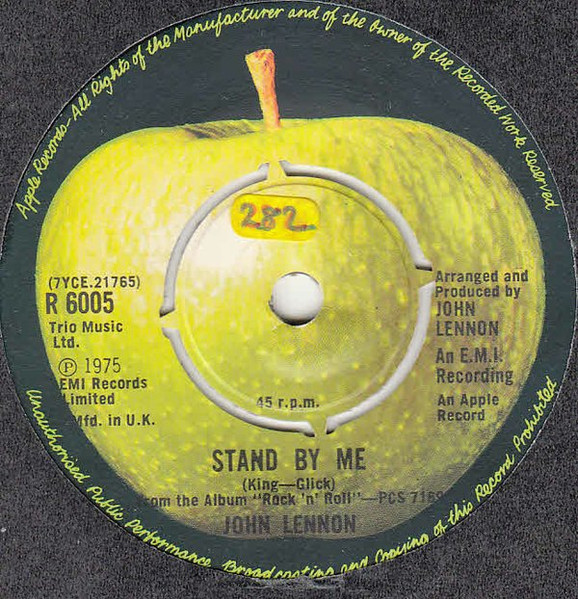
John Lennon: "Stand by Me"


"It's a song that would make a fool of anybody who didn't mean it. Lennon wouldn't have had to make it perfect. But he did."
— Pete Silverton

Prior to the events of December 8, 1980, John Lennon had never had a solo number one in his homeland. He hadn't even had a lot of big hits with just "Give Peace a Chance", "Instant Karma", "Power to the People", "Happy Xmas (War Is Over)" and a belated release of "Imagine" his sole Top 10 entries. Even some of his finest singles — "Mind Games", "Whatever Gets You Thru the Night", "#9 Dream", "Jealous Guy" when it finally emerged as a 45 in the mid-eighties — badly underperformed. Then, millions were stunned when he was assassinated outside his apartment in New York and they expressed their grief by buying up his records en masse. "(Just Like) Starting Over", a reissue of "Imagine" and "Woman" all succeeded each other as Britain's favourite single and another re-release of "Happy Xmas" nearly gave him a quartet of chart toppers. As if all of this wasn't enough, Roxy Music's cover of "Jealous Guy" would go on to a fortnight at number one soon after "Woman" faded.

People couldn't get enough of John Lennon — until they did. With all due respect to "Starting Over", "Imagine" and "Woman", it was his stronger material that ended up being ignored. The first possible casualty was Yoko Ono's "Walking on Thin Ice", an outstanding disco-new wave recording that Lennon famously worked on just prior to his assassination. It entered the Top 40 just as "Jealous Guy" was nearing the summit and both "Imagine" and "Woman" were fading away. Now, you can argue that a single by a mad avant-garde banshee was lucky just to sniff the pop charts but it is easily her most commercial work and a sign that Lennon hadn't left the underground behind completely. Did goodwill towards her husband's memory push it at as high as it got or did the coming backlash hurt its chances? Hard to say but "Thin Ice" deserved better.

I'll acknowledge the ambiguity surrounding Ono's single but there's no doubt that people had grown tired of mourning by the spring of 1981 — and Lennon's recordings were about to pay the price. After overachieving with Double Fantasy's first two singles both going to number one, the album's third release saw a comedown. "Watching the Wheels" proved to be popular enough to make the Top 10 in the US, Canada and Switzerland but the British weren't having it. An autobiographical account of Lennon's lethargy (in the tradition of "I'm Only Sleeping", "Good Morning Good Morning" and "I'm So Tired"; as I've written previously, he may have indeed been lazy but not so much that he didn't feel the need to write a whole host of songs on the subject), it's as soft rock as "Woman" (the use of backing vocalists in both anticipates Stock Aitken Waterman) but with much more of a lyrical edge. While many of his compositions of the time are poignant in light of his horrific murder, it's strong enough on its own. But people weren't touched by it and it only got to number thirty.

But at least it did something on the charts which is more than can be said for the re-release of "Stand by Me". Not a big hit when it initially came out in 1975, it was chosen as yet another attempt to milk the tragedy. This time, it would be with an oldie, something that wasn't guaranteed catch on (while "Imagine" finally gave him the number one that it always should've been, a reissue of "Give Peace a Chance" was just a minor hit earlier in the year). Still, the public weren't interested in hearing Lennon with some bite so why not continue to plunder his sentimental side?

Due to legal issues surrounding a line in Beatles' hit "Come Together", Lennon had been strong-armed into recording an album of old rock 'n' roll hits. While this clashed with his countercultural image, it was something he nevertheless embraced. Ian MacDonald described Lennon's feelings towards the Chuck Berry hit "Rock and Roll Music", which was covered on the Beatles for Sale album and is an absolute banger, as "virtual holy writ" and for sure he tended to sing standards as if they meant everything to him. Beatles' covers are something of a mixed bag (Paul's are mostly good, George and Ringo's generally aren't up to much) but John's are some of their best. "Twist and Shout", "Baby It's You", "Money (That's What I Want)", "Please Mister Postman", "You've Really Got a Hold on Me", "Rock and Roll Music", "Bad Boy": Lennon screamed and emoted his way through so many great songs that he didn't write but might as well have. Even "Mr Moonlight", a lot of people's least favourite Fab Four track (they've obviously never heard Ringo's pitiful — and possibly drunken — take on "Matchbox"), is aided by John's throat ripping plea in the intro.

So, an album of oldies had some promise ten years after The Beatles had given up doing covers. The Rock 'n' Roll album isn't brilliant from start to finish but it has its moments. Tellingly, however, there's a reason you seldom ever hear twelve of its thirteen cuts. As one would expect, Lennon's singing is first rate, his vocals the finest he'd recorded since The White Album. Musically, it's never more than competent. You'd be hard pressed to find cover that tops its original source material. With one exception.

"Stand by Me" stands out on the Rock 'n' Roll album for its quality and the sense that it's a song that meant a lot more to Lennon in 1974 than it did when it first came out. Covers like "Be-Bop-a-Lula" and "Bony Maronie" are charming and affectionate, throwbacks to his youth; this says as much about his state of mind at the time than the likes of "Help", "Strawberry Fields Forever" and "God" did when they came out. Notably, it is one of just two cuts on the album that isn't from the fifties. (Sam Cooke's "Bring It on Home to Me", which was used in a mediocre medley with Little Richard's "Send Me Some Lovin', is the other) Separated from Ono and in the midst of his Lost Weekend, the lyrics likely hit home and Lennon gives it a stirring reading as a result. 

The sole Lennon cover that ever crops up on compilations, "Stand by Me" could've appeared on either of the good-not-great Mind Games or Walls & Bridges albums and it still would've been a highlight. Yet it only just made grazed the Top 30 of the UK charts in 1975 and it fared much worse six years later — even though it appears not to have been a major release. In truth, there wasn't much reason for it being reissued beyond simply keeping the product coming. The public had expressed their sorrow in the aftermath of his murder but now it was time to move on. Further posthumous releases maintained the downward trend with the exception of brand new single "Nobody Told Me" from 1984's Milk & Honey. Ben E. King's original (which is slightly inferior to Lennon's) would later go to number one in Britain on the strength of a Levi's ad campaign proving that the song still had legs. And it still does to this day. Again, Lennon may not have written it but he might as well have.

~~~~~

Also Reviewed This Fortnight

Kraftwerk: "Pocket Calculator"

Seriously, this was a single? The Computer World album is nowhere near as great as some will have you believe (it doesn't touch either Autobahn or Trans-Europe Express) but it had better material to draw from this, in Pete Silverton's words, "silly song". It seems strange they didn't go into the realm of video games but perhaps choosing to spurn Atari in favour of Little Professor calculators must've been a joke for the German quartet. (If that is indeed the case then the gag is lost on me) Honestly, what can be said about something so throwaway being done by a massively talented group who must have had better things to do. Proof that (a) they were right to get into cycling and (b) this most influential of groups .

Thursday, 3 May 2018

Ian Dury: "Spasticus Autisticus"


"Personally, my flesh crawls each time I hear him shout "I Spasticus". And it hurts so good."
— Pete Silverton

It should be clear by now that minorities don't appreciate having every little thing explained to them by middle-aged white guys. When Bill Maher devotes a portion of each recent episode of his weekly program Real Time to discussing his perceived grievances with Me Too and doesn't bother including a representative from the movement then there's clearly something wrong. Week after week he's been wondering why these women are unable or unwilling to distinguish between horrific serial sex predators and those who've been accused of creepy though not necessarily illegal acts. Too bad he's unable or unwilling to listen to them; perhaps he'd discover that the vast majority are able to make those distinctions. And, so, he has found himself mansplaining an issue that doesn't exist: hard to believe feminists aren't on his side.

1981 was the UN's International Year of Disabled Persons. Using the slogan of "a wheelchair in every home", it was meant to raise awareness of the plight of the handicapped and how they were marginalised by society. It's arguable that this resolution produced a net good: the increasing prominence of disabled parking spaces and wheelchair ramps by the end of the eighties was likely at least somewhat attributable to the IYDP. Nonetheless, one of its critics was Ian Dury who considered it to be "patronising".

"Spasticus Autisticus" was Dury's reply to the IYDP and it's savage. The near-gibberish of some of the lyrics ("I wibble when I piddle, cos my middle is a riddle", "I dribble when I nibble, and I quibble when I scribble") might delude the listener into thinking this just one of his jolly music hall-inspired ditties. But when he gets to the more delicately sung middle part ("So place your hard-earned peanuts in my tin, and thank the creator you're not in the state I'm in / So long have I been languished on the shelf, I must give all proceeds to myself") you know he means business. It closes with the repeated shouts of "I'm Spasticus!" that made Pete Silverton so understandably squeamish. 

Ian Dury has always struck me as one of those odd British national treasures, much like, say, Frank Bruno or Tony Hancock, who have almost no recognition elsewhere. (Prior to becoming a bit more aware of him about twenty years ago, my only previous knowledge of him was that he sang the theme to the TV series The Secret Diary of Adrian Mole) But perhaps a significant portion of the esteem with which he is held in his homeland stems from his courage and bull-headed determination to be himself at all costs. He wasn't about to put up with busy bodies at the UN telling others how to treat him: he could do just fine informing them himself.

But would he have made of his protest song getting played at the Paralympics Opening Ceremony?

~~~~~

Also Reviewed This Fortnight

Portsmouth Sinfonia: "Classical Muddly"

It's hard to imagine how something like the Portsmouth Sinfonia managed to catch on (to the extent that they did). Either as deconstructionists par excellence to rival eyeball mask-sporting crazies The Residents or as the self-proclaimed 'world's worst orchestral' doing what they did, well, worst (or is it best?), the Sinfonia unleash a barrage of noises — some of which manage to be musical in some form or other — that make for a fun if awfully chaotic listen. The amateurism of the players is reinforced by the slapdash quality of the mix as the opening bars of Also sprach Zarathustra abruptly transitions into the William Tell Overture which in turn becomes Beethoven's 5th and so on — with the simplest of drum machine beats to barely hold it all together. A shame they didn't just record it all in one shot, though that might have made them sound too professional and there's no way they would have put up with that.

Kim Wilde: "Love Blonde"

21 July 1983 "Now that summer's here, I suppose the charts are likely to be groaning under the weight of a load of sticky, syrupy s...